Classification and association
Ihave been told that classifying and associating are the most powerful tools for acquiring new knowledge. Of course, one needs to be intelligent when assigning data to the correct classification, and classification is associated with intelligence. In short, a wonderful Catch-22. How to get out of it ?
Becoming aware of the way one classifies may help. For example, how do you remember the names and faces of people you meet for the first time? This is the theme of many books that try to help improve the memory in business management situations.
Furthermore, many IQ tests focus on pattern recognition and arriving at solutions to problems through a series of logical steps. In my experience, most of these tests are based on classification and association. Of course, this only views these words in a positive way but negative connotations are everywhere. We can think of classification according to your own or society's standards in that a person for instance, is good or hard-working. The other side of the coin includes racism and class difference. In short, classifications are often associated with emotional, cultural and moral judgements.
These judgments are intertwined at such a deep level that the logical link has disappeared, leaving only the emotional factors involved in the original association. You can't change reality, but you can change your interpretation of it.
Since go is more limited in its reality than real life, though, it is easier to verify one's interpretations of one's sense of reality. It then becomes clear that by making the correct associations one can become stronger. In order to facilitate the way you learn go, from now on I will classify the column according to the level of difficulty.
** represents beginner's level while **** most advanced.,
Connections (*-**)
Instantly recognizing if two stones are connected or not is important to understanding reality on the go board. Basically there are four classifications of how two stones are connected and two types of each of them.
In Diagram 1, these black stones are connected in the most basic way. In Diagram 2, these two black stones are connected only by the virtue of A and B being miai (White plays A, then Black plays B, and vice versa). This connection is called kosumi. In Diagram 3, these two stones are connected by an ikken-tobi (one-space jump). There is an obvious weakness at A. In general these stones are connected, but watch out. In Diagram 4, the black stones here are connected through a keima (similar to the knight's position in chess). This connection is weaker than the one in Diagram 3 because there are two places for attack, A and B. In Diagram 5, this connection is called the nikken-tobi (two-space jump) with serious weaknesses at A and B. In Diagram 6, this is the ogeima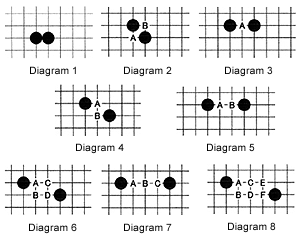 (large knight jump) and this move has its virtues, especially close to the edge on the second, third and fourth line. It combines speed with flexibility but sacrifices strength and White could start a cutting action with A through D. In Diagram 7, this could be called the sangen-tobi (three-space jump) but in practice this reference is rarely made, simply because it is only used as a sort of an extension on the third and fourth line. White can try to cut at A, B or C, but B stands out as the first place to look for a way to cut. In Diagram 8, this is also more an extension than a way of connecting. It is usually employed on the third and fourth line. White has a multitude of ways of cutting. Stones farther away are not viewed as a connection although they can form a framework. There is not a specific trick to knowing the right move. A host of considerations ranging from speed, flexibility, strength, direction and personal style come into play to determine your next move.
Problems
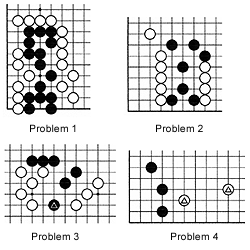
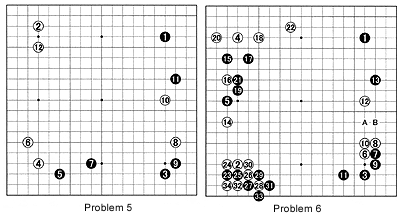
In Problems 1, 2 and 3, Black has serious defects in the way his stones are linked up. What are they? In Problem 4, a common situation arises. How does Black take advantage of the weakness in the connection between the two marked stones? In Problem 5, the development in this diagram is a common one. White 12 is a mistake as he should have reinforced his weak stones 8 and 10. How can black take advantage of White's mistake ? This is a problems for more advanced players, mainly because the solution defies common sense.
Hint: Don't think about invading but about something more rigorous.
In Problem 6, this diagram shows another common development. What to do about the weakness of the three-space jump on the right side? Black A and B look like the correct move, but in fact there is a better approach.