
Yoda, the new hero (***)
Last week, Cho Chikun lost his last remaining title, the Meijin title, to Norimoto Yoda. For the first time since the Heisei era began 12 years ago, Cho is without a title. Whereas he had always been referred to as "Cho Kisei," "Cho Honinbo" or, until last week, as "Cho Meijin," I happened to be in an adjacent room when the news broke and even though I could not hear the result, I heard the words "Cho, 9-dan" -a real shock to hear Cho's name mentioned without his title.As he often lost the first three games in a best of seven series, and then went on to win the next four games, Cho was known as a comeback master. But after he lost his other two titles, people whispered that Cho had lost his touch. However, judging from the fourth and last game of the Meijin series, I had the impression that it was not Cho who lost by playing badly, but rather it was Yoda who overpowered his opponent psychologically by imitating his style-using shinogi, effectively using countering moves.
Solutions to last week's problems
For last week's theme, we chose two seemingly contradictory proverbs: "Do not make moves that strengthen your opponent !" and "When in trouble, attach !"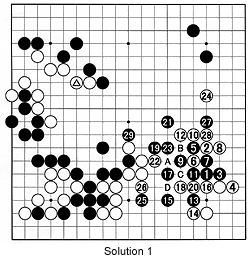 Solution 1 : This game between Honinbo Shusaku (White) and Sendaiu Sekiyama (Black), illustrates both proverbs simultaneously. After White settled his group with the marked stone, it is Black's turn to erase White's moyo (framework or potential territory) on the lower right. This diagram shows the 29 moves from the moment Black starts his advance to the moment he more or less connects his invading stones to the outside world.
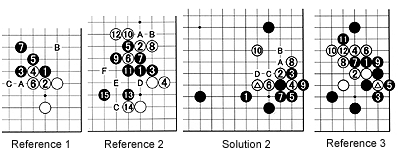
Reference 1 : To invade in (uchikomi) or erase (keshi) a moyo, leaning and attaching techniques are employed frequently. Although this contradicts proverb (A), this technique is employed in an area where your opponent is strong already, so you do not mind making him even stronger. But your main intention is to make your own stones stronger. In playing at 1, Black uses this technique. Now it would be a mistake for White to go along and answer meekly with 2, 4 and 6. (Remember these moves are contact plays.) After black 7, A or C and B are miai (if Black plays A or C, White plays B-or the other way around).
Reference 2 :
For the remainder of the moves given, look at the Solution 1 diagram. For example, white 22 skillfully creates a cut (white can exchange A for B, then cut at C or D at any time). John Power's book "Invincible" offers an in-depth analysis of this game.
Solution 2 : To reduce the influence of the double wing formation, White plays a tsuke at 2 in response to black 1, with the aim at giving his invasion stones a light shape (sabaki). After black 3, white 4 is another tsuke that exploits various weaknesses in the corner. If Black answers with 5 and 7, White makes a good shape with 6 to 10. Note that black A is answered by B and C by D. Black can capture one stone but White gets thicker and thicker.
Reference 3 : Instead of passively following orders, after White's move (marked stone), Black may try playing at 1, before defending with 3. White 4 is an elegant move that leaves bad aji (potential) in the corner. Black 5 is the strongest move, but after the sequence to 12, White is in fairly good shape.
 Diagram 1 : Shows the first 28 moves of a game between Cho (Black) and Yoda, 9-dan. Even though he usually likes building up small, strong positions (on the 3rd line) in order to invade afterward, in this game, Cho develops his position quickly to build a gigantic moyo. On the other hand, while Yoda likes to play on influence, such as on the 4th line, he starts out slowly with moves such as 12. An alternative would be playing at 13. Instead of black 13, Black could have played at 14, almost forcing White to invade. The erasure move (keshi) of white 14 is good timing, aiming at invasions here and there while keeping Black's moyo in check. White 16 is a light move, again more a keshi then an invasion. Black 17 forces White to connect his two stones. Instead, answering with 18 would be out of the question. Black 19 seems natural, but should have been at 20 to split the two groups apart, according to some experts. The moves to 27 are natural. Black 27 could have been at A. White 28 is a tsuke, aiming at settling himself quickly.
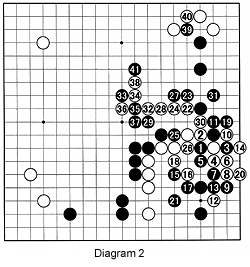 Diagram 2 : Shows the moves 29 to 69. Black 1 and 3 are a violent counterattack. To save his own skin, White is forced to play the moves to 14. Note the subtle order of play-6 and 8 are played before 10. Black 15 prevents White from peeping (nozoki) at 16. Black 19 before defending at 21 is good timing. To escape, white plays another tsuke at 22. When White plays 32 he seems to have pulled his stones out. And as wonderful as Black's move at 33 is, so is White's answer at 34. Black 35 is forced now as are the moves 36 through 38. Black 39 prepares for his next attack. Black 41 however is of a highly doubtful nature. The battle is really joined over the next 50 or so moves.

Problems
Problem 1 : Instead of 41 in Diagram 2, Black could have played elsewhere and he could possibly have won the game. Where should Black have played ?Problem 2 : Black 1 seems to doom the marked white stones. If White plays at A, black B will kill the group. If it is White's move, how can he keep these stones alive ?