
Finally in 1999, she emigrated to South Korea, where she became the first woman to win a title open to all male and female professionals in an Asian country by defeating veteran Cho Hun Hyun in the finals and Yoo Chang Hyuk and Lee Chang Ho in earlier games. The three South Koreans are among the world's top 10 players.
The Autumn 2000 issue of Go World, the leading English-language go magazine, features her life in "The World Her Stage-the Rui Naiwei Story."
Aggressiveness rules
In general, Rui's style is aggressive and provocative, backed up by an in-depth reading of the board, guts and pragmatism. Her style and attitude have been a positive force for women in the South Korean go world, rapidly raising the country's level and resulting in more publicity, new sponsors and new tournaments.Let's have a look at one of her games, with Rui (White) playing Lee Chang Ho, who captured the world title at the age of 16 and is known for his impeccable positional judgement and endgame.
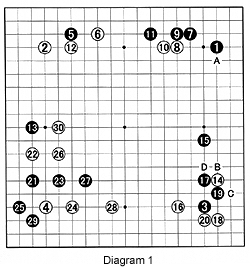 Diagram 1 : With 8 and 10, White aims at getting outside influence and attaching at A. By playing 13, Black indicates he wants to avoid a battle right away. The moves 15 to 20 form a joseki that has become popular recently. White aims to play B later, making miai between D on the one hand and C on the other.
White 22 is one of Rui's trademark in-your-face moves-the aim is to start a fight as soon as possible. Black abandons 13 temporarily and focuses on the lower side first. The moves 23 through 29 show Lee is primarily concerned with making eye-shape and to open access to the center.
Over the past three weeks we have studied boshi (capping moves) and a lot of them can be seen in the lower left corner.
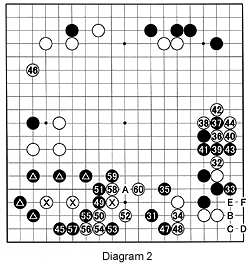 Diagram 2 : The marked black group is strong, so Black attacks with 31 to split White's groups. White has to defend at 34, but only Rui could come up with a move like 32. It enables the sequence 36 through 44 but the end-result is not very good as Black becomes thick and gets to switch to the lower edge first with 45, undermining White's marked stones. White 46 clearly shows Rui's attitude that says "Do your worst !" A lesser player would probably defend somewhere on the lower edge.
Black 49 is too small in scale; he should have played at A. If he had, White, in its struggle to survive, would have helped Black build thickness and that would adversely affect White's left side. Moreover, Black could make a hanami ko in the lower right corner by playing B, which would be followed by white C, black D, white E, black F. However, Black plays 53, a move that is out of character for Lee as it is too local.
We will return to this game next week.
Solutions to last week's problems
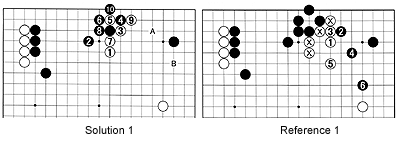
Solution 1 : White 1 is a good move. Usually White answers by playing keima in the direction of the widest extension. The moves to 10 are natural. White's next move should be around A or B to attack the lone black stone in the upper right.
Reference 1 : White should not make the mistake of playing at 1. This gives Black a good excuse to play a nozoki at 2. After the moves to 6, Black's upper right corner is stable but White's group of marked stones will be prone to attack later.
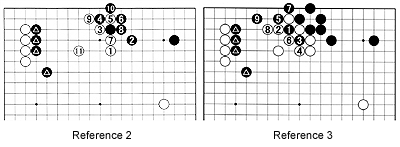
Reference 2 : On the other hand, if Black chooses the keima of 2 and plays the middle-game joseki to 10, White's move at 11 puts the black marked group in danger. What happens if Black cuts somewhere ?
Reference 3 : If Black cuts with 1, white 2 and 4 are excellent moves. Black can connect his marked stones underneath with the sequence to 9, but that will leave him with no chance to attack the white group in the center.
Solution 2 : Boshi at 1 is a good move for White. Black will most likely answer with 2. Now the moves 3 to 7 form a tesuji combination, forcing Black to answer with 8 (a Black move at 9 is no good because of White's earlier exchange of 3 for 4). White 11 and 13 are the next combination. However, somewhere along the line, Black may offer resistance, and therefore it is probably safer to leave the moves from 3 on as a threat and reinforce first around A, a move that provides an escape route to the center.
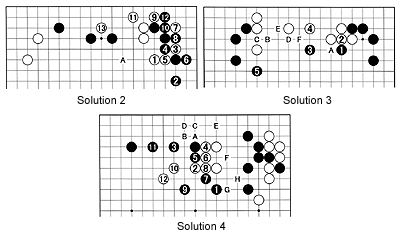
Solution 3 : Black 3 is the move to aim for, but before doing so exchanging 1 for 2 is a good idea (if Black exchanges 3 for 4 first and then plays at 1, White might resist with a move at A). A boshi at 5 is a good move. White will have trouble finding an answer as Black has forcing moves at B, black C, white D, white E, or alternatively by simply playing at E, which White has to answer somewhere at the top. Also note that once White answers with 3, black 4 will be a boshi.
Solution 4 : Boshi at 1 is correct-it opens up Black's path to the center while blocking White's. White 2 is a similar move. Black 3 is necessary now (this aims at nozoki at 6), making white 4 necessary. The moves to 12 look natural. White has some scope for eyes by playing A, followed by black B, white C, black D, white E (although Black might counter with a move at E instead of D), or at F, which also threatens cutting maneuvers at G and H. I prefer Black as he has the initiative and is making territory on the upper left while attacking.
Problems
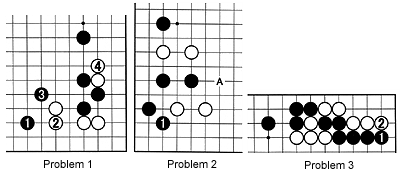
Problem 1 (intermediate): In the Rui-Lee game, White answered black 1 (31 in Diagram 1) with 4. What if she defends with 2 and then plays 4. How would Black respond then ?
Problem 2 (intermediate): In the game, Black played at A (27 in Diagram 1), but if he had played at 1 immediately, where should White play ?
Problem 3 (beginners): A variation on this problem appears later on in the game. In the situation shown here, Black can kill White unconditionally. What are Black's next three moves? (Hint: Make the living space smaller first then hit the vital point.)