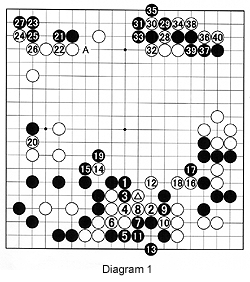
 Diagram 1 : White 60, the final move last week, is indicated by the marked stone. The sequence black 1 to 13, which really followed black 53 (next to black 5 in this diagram) in a 20-move sequence, was brilliant because Black manages to survive in an extremely confined space. But overall he loses out.
White connects her weak group by capturing two black stones (black 9 and the stone above) with the sequence 12 to 18. The exchange 14 for 15 may have been White's only doubtful move. White is forced to retreat with 20 after Black's reinforcement at 19. This gives Black the chance to invade the upper left corner. The sequence to 27 is possibly the first time ever for this particular pattern to appear on a go board. Black is aiming at A. Now it is White's turn to move into the upper right corner.
White's sacrifice at 30 ensured Black would answer 32 with 33. White cuts with 34 in order to play the combination of 36 and 38. With her next move at 40, White shows a potential to live, endangering Black's stones in the corner at the same time. As you can see, Rui's style is not one of peaceful symbiosis-it is either you or her, and most often her in recent tournaments.
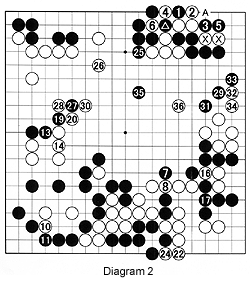 Diagram 2 : Black 1 is a clever move. But to understand this we need some background information. Look at Solutions 3A and 3B. In those diagrams, Black descends first to the second line before playing the deadly hane at 1. However, unlike these solutions, White was not planning to just play at A and quietly watch her own funeral. She played 2 in a direct challenge for the ko. Without the exchange on the second line, at least in this game, black 3 and 5 take the corner. However, this was a mistake (see problem 3). In the end, Black won the ko that followed. Note that black 9, 15, and 21 are at the place where the marked black stone is, while white 12 and 18 are played at 6; in addition black 23 is played at 1. After losing the ko, White kills the black group at the lower edge with 22 and 24.
Black also played such moves as 13 and 19, which were captured, while White builds up her strength in that area. Black loses points through mochikomi (losses without compensation). However, Black plays at 27 in an attempt to regain the advantage. White answers with 28 and then 30, a safety-first move that is gote (loss of tempo)
Black uses his sente (a move that should be answered) by playing 31 and 35 to try to build center territory. White compromises by offering the besieged four white marked stones.
There is not enough space to play out the full game, but White not only saves her four stones but goes on to capture some black stones. At that point, Lee threw in the towel and Rui defeated him 3-0 in this series.
Solutions to last week's problems
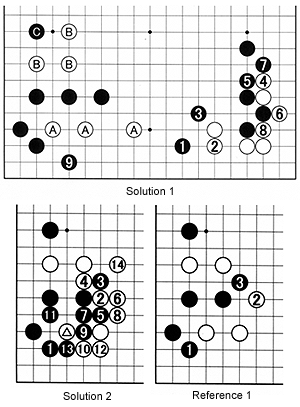
Solution 1 : After black 1, if White first answers with 2 and then plays 4 after black 3, Black will allow White to connect underneath with 6 and 8. In exchange Black gets a lot of thickness that will certainly come in handy when he attacks with 9. The white stones marked A are in trouble now. During White's struggle to make eyes to escape, Black will build more thickness that will hurt the White stones marked B and allow Black to escape with his stone C.
Solution 2 : If Black plays at 1 right away, White 2 is an ideal move to stop Black from breaking through to the center. Black can try with 3 and 5, but in the end he will have to retreat with 7 and 11. Sacrificing the marked stone is not a high price for White to pay for the overwhelming influence he is permitted to build with 12 and 14.
Reference 1 : Sometimes following the proverb "Your opponent's vital point is your vital point" is a good guide to your next move, i.e. white 2. But this leaves Black free to move into the center with 3, which Black may not necessarily play immediately.
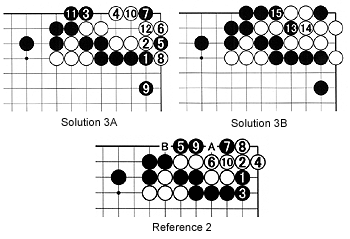
Solution 3A and 3B : Descending with 1 combined with the hane at 3-5 and hitting the vital point with 7 is a standard combination here.
Reference 2 : Playing hane right away allows White to live with 2 and 4. Now, playing a hane at 5 is answered by 6. Black 7 and 9 look clever but at 8 and 10 make it impossible for Black to rescue his stone at 7. A and B are miai, i.e. if Black plays one, White plays the other.
Problems
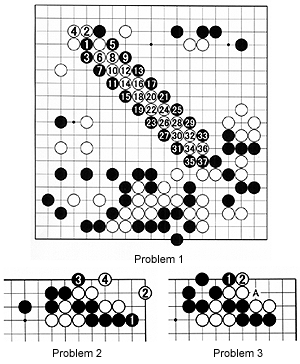
Problem 1 (beginner): In the game, Black played 21. He could have played at 1. The moves to 5 would follow. If White tries to escape with 6, he will be caught in a ladder. However, instead of 6, White will play a move that will break the ladder and be a forcing move on the lower right, too. So instead of 6, where would White play to block the ladder so that it becomes a double threat ?Problem 2 (beginner): Refer to solution 3A. No look at white 2 in the problem. Is it possible to kill White? (Hint: Start with exchanging 3 for 4 and refer to Reference 2 for the move you should not play). Where should Black play to kill the corner ?
Problem 3 (intermediate): After the exchange 1 for 2, instead of A, Black has a simpler and better move. How should Black play his next few moves? (Hint: It will become a ko, but different from the one in the game).