
Changing your mind (**-***)
When flipping through a recent issue of a popular science magazine, I came across an article that offered support to something I believed in. Intelligence, the article argued, was not related to the number of brain cells but to the number of synapses, connections or junctions through which nerve impulses travel.If we compare a brain cell to a computer, then the brain resembles a computer network far more extensive than the World Wide Web. In communications, what it important is speed and the number of connections that firms, including Internet companies, offer to users that have different needs-quantitatively or qualitatively.
In the brain, new paths between cells are forged as the need arises for those cells to communicate. And existing paths physiologically widen when the information increases in quantitative terms. Alternatively, a path may wither if few nerve impulses travel across it.
A well-traveled path implies that the same thought or action occurs frequently. This may imply a habit, good or bad. And that is why people behave the way they do. But bad habits can be eliminated. According to one authority, to become as successful or admirable as a person you esteem, you should emulate that person. That is all your brain needs to know to change its way of thinking.
With that in mind, let us start with some solutions instead of problems.
Solutions 1A and 1B: Black 1 adheres to the principle of first restricting White's eye-space (territory) and then striking at the vital point with 3. Black 5 and 7 are a matter of course. Even if White captures black 7 with A or the black marked stone with B, the space that then appears is not a real eye-it is what we call a false eye, because, eventually, White will have to play there (alternatively, Black can play there after first filling in the outside liberties).
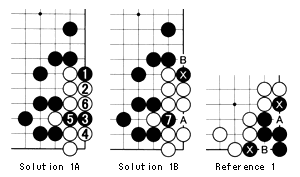 Reference 1: Basically, this is the same situation as what we see here. Some people may argue that A and B are eyes because White cannot capture the whole group at the same time. But the marked black stones are in atari and White can capture either of them whenever he chooses. As Black cannot prevent this, the black stones are dead.
Death in the hane
First of all, what is a hane? (Hane is pronounced ha-ne "ha" as in hasten and "ne" as in never.)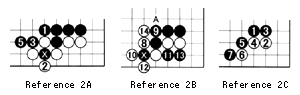

Reference 2C: Often Black will choose to not play at 11 in Reference 2B but play at 1 here. If White plays 2 at 3, Black will go back to the previous diagram and play at 11 there. For White, capturing the marked stone with 2 is correct. Black 3 is followed by a white connection where the marked black stone is. And with 5, Black takes control over the center.
Solution 2A: The hanes of 1 and 3 are correct. White 4 is one vital point, but black 5 takes the other one. After black 7, A and B have become miai (White takes one, Black takes the other).
Solutions 2B and 2C: White 2 is a devious move, but if Black just plays 3 and 5 to restrict White's eye-space and then play at the vital point at 7 and 9, White is dead. After white 10, the throw-in of black 11 makes that space into a false eye. If White tries to escape with 12, black 13 stops him from doing so.
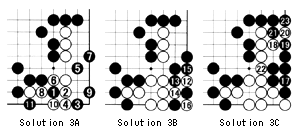
Solution 4: In jumping as far as 1, Black optimally restricts White's space. In the sequence to 15 it becomes apparent that White is dead.
 Reference 4: True, black 1 and 3 take two vital points, but white 4 makes use of damezumari (Black's marked stones are in atari on his next move, black 5), making black 7 necessary and giving White the opportunity to play 8 which splits up his territory in two distinct areas, making two eyes.
Next week we will look at some strategy.
(The number of h indicates the difficulty level with one representing beginner and five the most advanced.)